
20 November 2025
Professor Stefan Kramer of Mainz University is a computer scientist dedicated to Data Mining driving the advancement and application of artificial intelligence. Last year, Rhineland-Palatinate’s Minister-President appointed him as the state's AI Pilot for the Life Sciences. In our JGU Magazine, Stefan Kramer talks about his experiences so far, his future plans, and the potential of AI in the life sciences.
Whether navigating uncharted currents or hidden shoals, maritime pilots are indispensable for steering ships safely through dangerous waters. Pilots, however, operate in many other fields as well – including those guiding the adoption of artificial intelligence (AI). In August 2024, computer scientist Stefan Kramer, Professor of Data Mining at Johannes Gutenberg University Mainz (JGU), was appointed the AI Pilot for the Life Sciences for the state of Rhineland-Palatinate by its Minister-President Alexander Schweitzer.
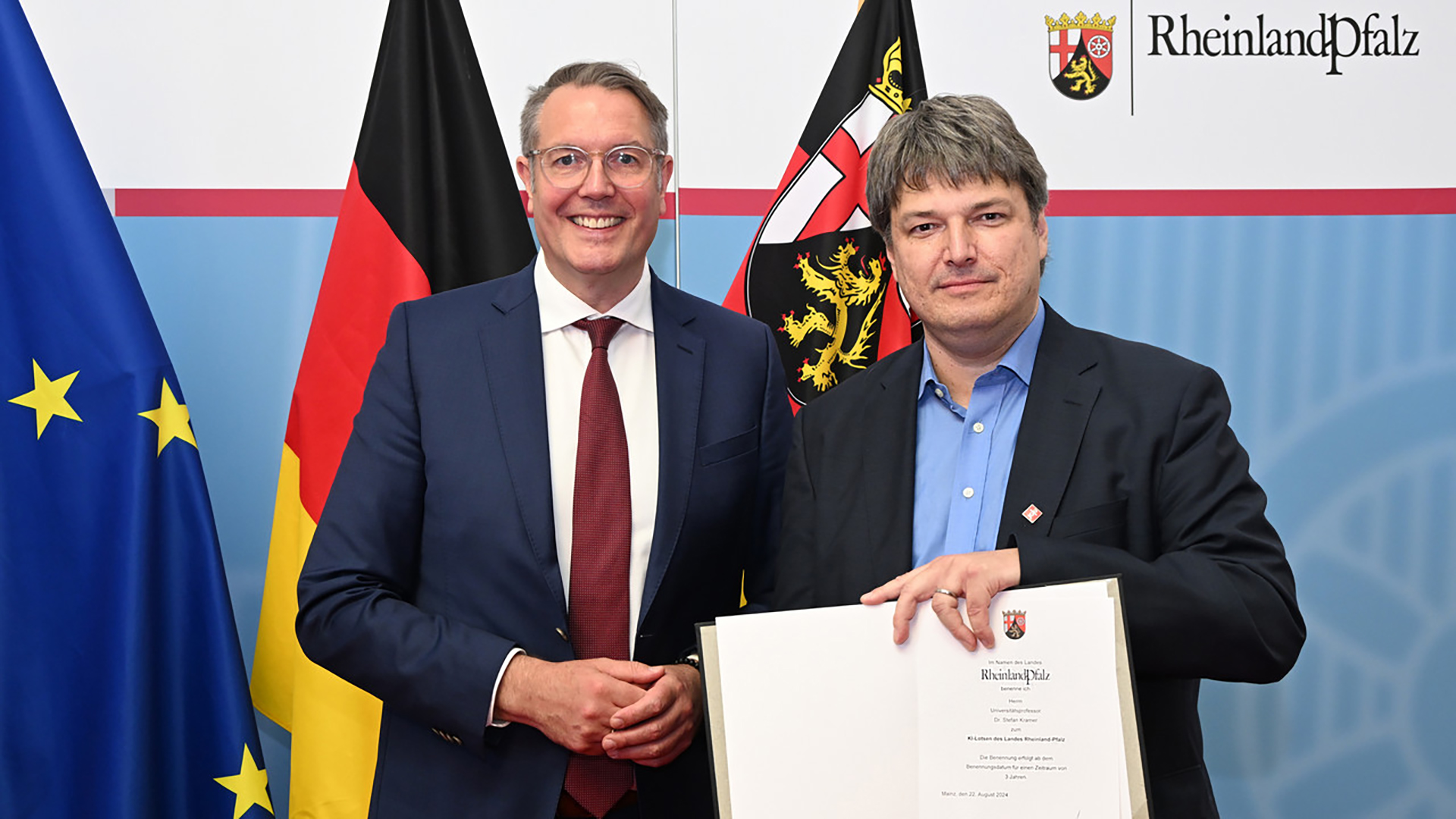
After a year in this role, what conclusions does Professor Stefan Kramer draw from his experience so far? "My work as AI Pilot is fascinating because it connects me with a broad range of partners across Rhineland-Palatinate," he reports. In addition to businesses and institutions of higher education, he highlights partners such as the Life Science Center Mainz, the BioVation RLP networking platform, the biomindz Life Science & Biotechnology Hub, and the federally funded Cluster4Future curATime – Cluster for Atherothrombosis and Individualized Medicine. "We collaborate actively also within Johannes Gutenberg University Mainz – for example with the JGU Institute for Quantitative and Computational Biosciences, the ReALity: Resilience, Adaptation and Longevity network, and the chemical sciences, including areas such as drug discovery research," Kramer adds. "And there are also very important links with the Mainz University Medical Center."
Networking, informing, inspiring
How exactly does the computer scientist, born in 1969, support businesses and organizations in Rhineland-Palatinate in staying on course when it comes to using artificial intelligence in the life sciences? "In practice, this mainly involves networking and sharing information – for example, by outlining emerging topics and trends for the sector," Kramer points out. And there is substantial demand for this as 2025 has seen extensive automation in the life sciences, from data analysis to laboratory workflows. The automated identification of highly promising drug candidates and advances in materials research are just two examples that Kramer cites.
During the interview, Professor Stefan Kramer radiates an infectious enthusiasm for his role as AI Pilot. He sees himself not only as a guide for AI in the life sciences but also as a committed ambassador for the field. His central aim is to link individual applications and, in doing so, systematically expand the broad field of AI in Rhineland-Palatinate, a state that has already established itself as an international hub for biotechnology.
The bigger picture beyond AI applications
In his own research work, Kramer engages with broader questions surrounding AI – issues such as fairness, transparency, and data privacy. "Although AI applications are more strictly regulated in Germany than, say, in the United States, there is not necessarily a genuine interest in industry to actively address these topics," he notes, offering a critical view of current developments.
Kramer describes himself as a "computer scientist by birth," but one with a strong philosophical bent. His deep interest in both fields is reflected in the subjects he chose to study: computer science at TU Vienna and philosophy – with a strong focus on philosophy of science and philosophy of language – at the University of Vienna. Kramer was still a student when AI first emerged and practical applications in science and industry began to take shape. "Back then, the discipline was still very young, and machine learning had been around for only about ten years," Kramer recalls.
A key moment came in 1994 at an international machine learning conference at Rutgers University in New Jersey. Experts there were discussing ways to apply artificial intelligence in the life sciences, while early AI applications for analyzing protein structures were already emerging. "That was when I realized this was not just interesting, but also extremely relevant," Kramer recalls.
Numerous success stories
Five years later, Stefan Kramer completed his doctorate in Vienna. He then worked in both academic and industrial research before moving to Freiburg for his habilitation. In 2003, he became Professor of Bioinformatics at the Technical University of Munich. From there he moved to Mainz University, where he was appointed Professor of Data Mining at the JGU Institute of Computer Science in 2011. Since then, the discipline of computer science has made remarkable strides. "The number of staff at the institute has tripled, external funding has increased tenfold, and computer science at JGU has produced numerous success stories," Kramer notes.
Kramer points out that many areas of AI development are shaped in the public eye by large technology corporations. This makes university-based research and teaching all the more important. Kramer himself is involved in research on neurosymbolic AI and relational learning. Among other things, this involves exploring how knowledge graphs and other complex structures can be applied to machine learning methods. One objective of this work is to reduce AI hallucinations and false inferences, making artificial intelligence more reliable and trustworthy. Of course, JGU is not the only university conducting research in this field. "But we're doing pretty well," Kramer says.
Unprecedented momentum in Rhineland-Palatinate and Mainz
When asked about the potential of AI in biotechnology in the region over the coming years, Kramer is fully confident: "From the development of new therapeutic agents to innovative approaches in diagnosing diseases – the range of applications is immense." He considers Rhineland-Palatinate, and especially the state capital Mainz, to be well positioned in this regard. "Both the state and the city are experiencing unprecedented momentum in this field, supported in recent years by smart, targeted investments." According to Kramer, this momentum now needs to be sustained and extended – through thoughtful recruitment strategies at universities, by attracting suitable businesses and non-university research institutions, and also by strengthening infrastructure, including laboratories and IT facilities.
The AI Pilot himself is involved in this process at multiple levels – from giving keynote speeches to liaising with the ministry to participating in dinner clubs and other outreach events aimed at engaging the broader public. "The challenge is to present complex subjects in a way that is both clear and suitable for each audience," he notes. Most recently, Kramer translated a hands-on Finnish book on AI by Hannu Toivonen into German, with both authors contributing new material to the German edition. In October 2026, Mainz will host the second International Conference on Artificial Intelligence for Science, AI4Sci 2026. And there are plans to produce a series of videos for diverse audiences on the JGU campus, designed to inform viewers and foster networking.
For his own university, Kramer has a clear priority concerning the challenges facing the field: "Computer science at JGU needs to be further strengthened, including within the strategic alliance of the Rhine-Main Universities." In general, Kramer advocates close and productive collaboration among research institutions. His long-term vision is "a kind of CERN for artificial intelligence" – an AI research hub that brings together expertise from across Europe to ensure European sovereignty in one of the most important scientific fields of the future. "This would have positive effects not only for Europe, but for the whole world," Kramer concludes.
Text: Peter Thomas / Translation: JGU