
29 August 2026
The Indian sport of Kho Kho demands speed and strategy – and recently became part of the University Sports program at Johannes Gutenberg University Mainz. Sports science students Levin Weckenmann and Niklas Gebhardt, who competed for the German national team at the first Kho Kho World Cup in New Delhi in 2025, brought this sport to the Gutenberg campus.
Germany had yet to score in its World Cup match against Kenya when Niklas Gebhardt launched into a sky dive. "That's a special way of tagging someone in Kho Kho," the student explains. "You jump and try to touch your opponent while you’re still in the air." His leap earned Germany its much-needed first point and gave Gebhardt "a really cool moment, a true highlight of the World Cup." And all this in a sport the rules of which he had only just learned.

By now, Gebhardt knows those rules inside out. "Kho Kho is like a complex game of tag," says the sports science student at Johannes Gutenberg University Mainz (JGU). "It has very little to do with simply chasing after someone and tapping them." In this traditional Indian sport, two teams compete against each other: one team gives chase, while the other tries to avoid being tagged for as long as possible. The chasing team must follow specific rules and strategically bring teammates into play. The result is a fast game with short sprints, sudden changes of direction, and a lot of strategy," Gebhardt says. "You have to use your head and think ahead so that you don't lose time."
Grass stains, sore muscles, and lots of fun
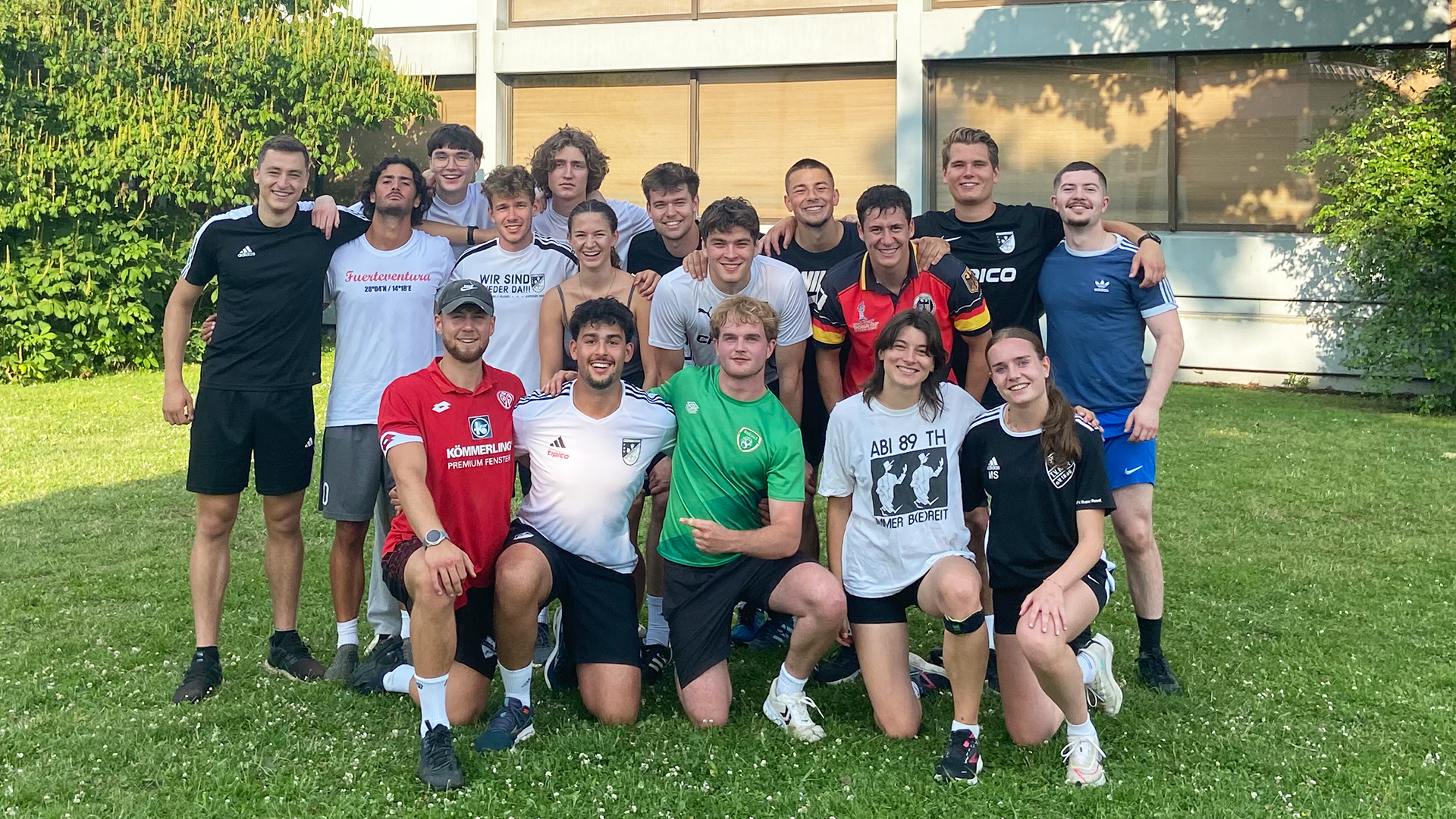
Together with fellow student and World Cup teammate Levin Weckenmann, Gebhardt has been running a Kho Kho class through JGU's General University Sports program, known by its German abbreviation AHS for "Allgemeiner Hochschulsport", for the past three semesters. Played on a grassy field next to the sports center, the game can look unusual at first. Players sit in a row on the ground while others suddenly jump up, sprint off, and dodge one another. At either end of the field, players must run around poles to change direction. They constantly switch direction, calling out "Kho!" and other commands.
"You have to be fast, but you also have to think," explains Levin Weckenmann, who, like Gebhardt, is in his sixth semester of sports science. "There are rules, tactics, and lots of changes of direction." Still, the Wednesday afternoon sessions are more about giving the game a try than competing. "We mainly play for fun, and there is a lot of laughter," Weckenmann says. "You might go home with grass stains on your pants. And get sore muscles at first because the movements are so unfamiliar."
Gebhardt and Weckenmann first heard about Kho Kho from an athlete they knew. She told them that the newly formed German Kho Kho national team was looking for players. "I had never even heard of Kho Kho," remembers Weckenmann, who has played soccer at the same club as Gebhardt since they were children. "And suddenly we were talking about going straight to the World Cup. At first, I thought Niklas was joking." Still, they both agreed. "It just sounded like a once-in-a-lifetime opportunity," Gebhardt says.
Light shows, national anthems, and a livestream
Only a few weeks remained until the World Cup in New Delhi. That left just enough time to learn the rules and attend a two-day training camp in Berlin shortly before the flight to India. In India, where Kho Kho has a long tradition, the JGU students experienced the sport at a professional level for the first time. Matches were played in an indoor arena with seating for 10,000 spectators, on special mats with fixed court markings.
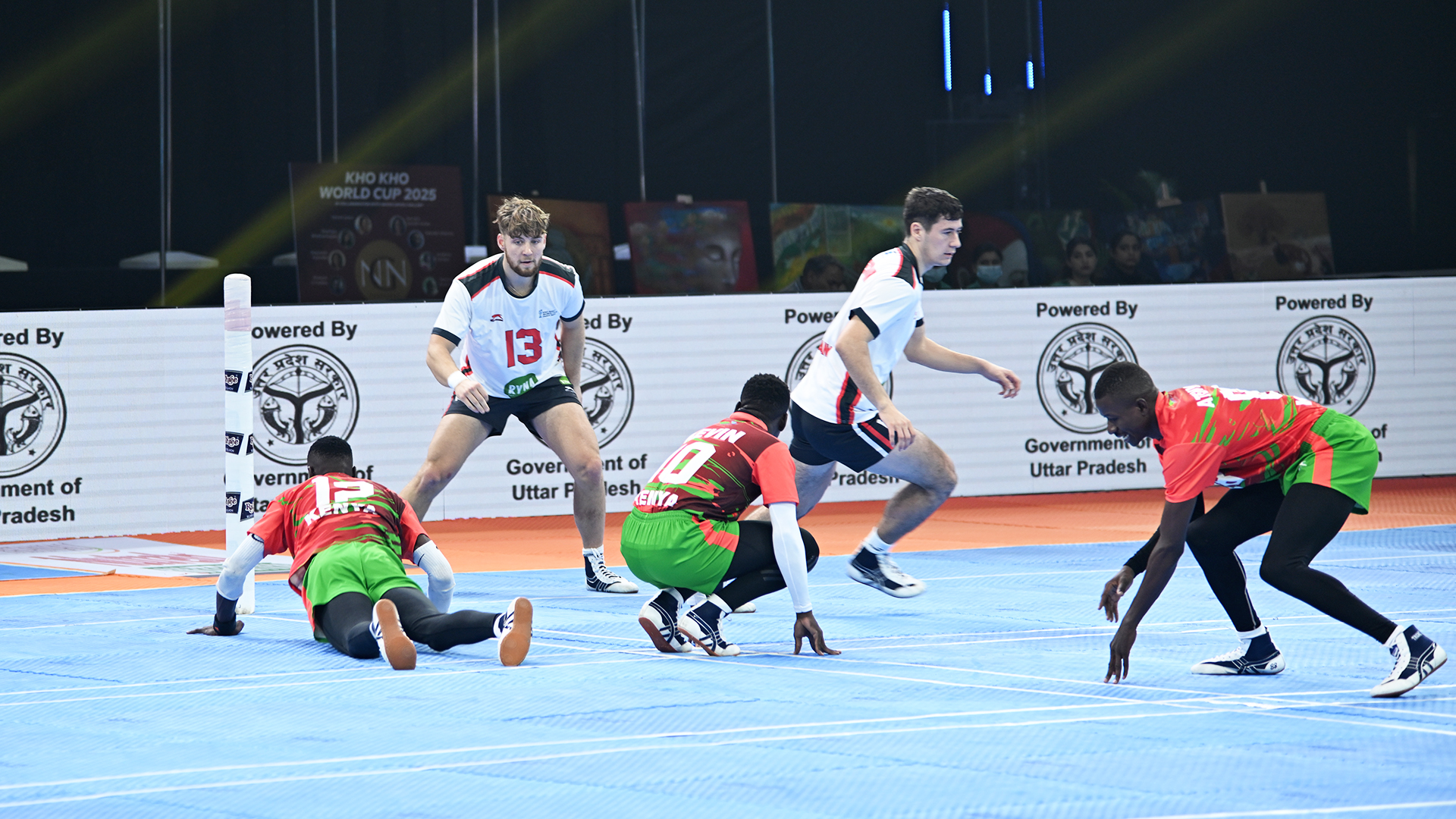
"The poles were firmly anchored to the floor, so you could really hold on to them and swing around them when changing direction," Levin Weckenmann recalls. The players wore wrestling shoes for better grip, and their uniforms were different from what they had expected. "We were given jerseys and very short shorts, and at first we thought, 'Did they give us size XS?'" In Kho Kho, however, touching a player's clothing also counts as a tag, so the shorter shorts gave opponents less of a target.
The two students from Mainz experienced an unfamiliar sport at the highest competitive level, complete with a light show, national anthems, and a livestream on YouTube. When Gebhardt challenged a decision during the match against Kenya, the officials used video review to determine whether he had actually been tagged. "Several referees watched the scene for a long time while the match was paused," he recalls. In the end, the referees ruled that Gebhardt had not been tagged after all and could continue playing. "That definitely makes you feel a little like a professional athlete."
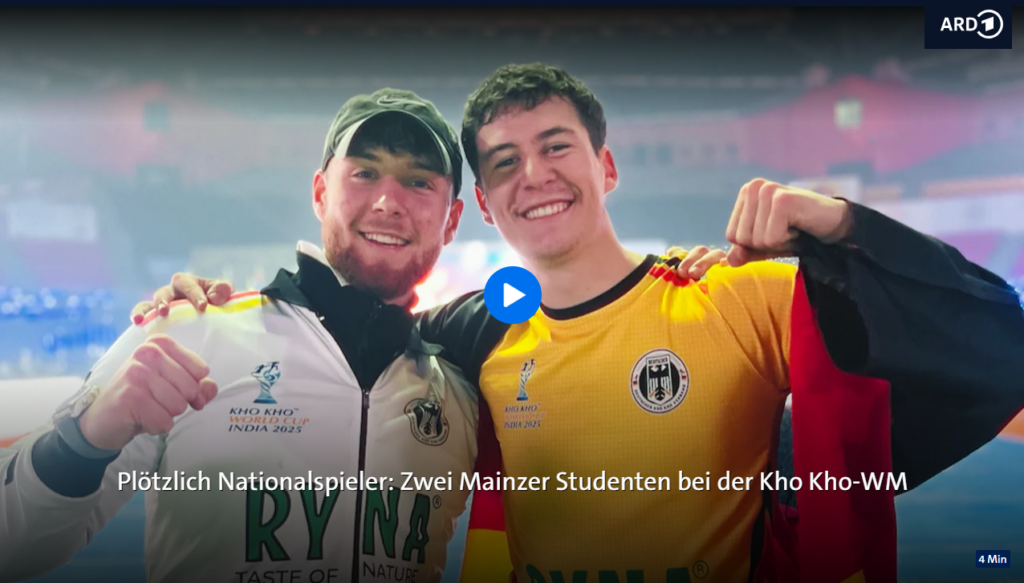
Suddenly on the National Team: Two Students from Mainz at the Kho Kho World Cup (Link to the ARD Media Library [in German])
From aikido and wheelchair rugby to parent-and-child exercise classes
"When it came to the game itself, however, we quickly realized that we were clearly outmatched," Weckenmann recalls. "Many of the more experienced teams played much faster, more precisely, and with far more confidence than we did." Germany was eliminated after four matches in the preliminary round. "But we still had the time of our lives," Gebhardt emphasizes.
Back in Mainz, the two students wanted to share their enthusiasm for a sport that remains largely unknown in Germany. They approached Dr. Patrick Hegen, head of the University Sports program, and offered to run a class. For Hegen, Kho Kho was a good fit with the program's mission. "University sports programs are designed precisely for niche activities like this," he explains. "Alongside traditional sports such as soccer and basketball as well as Body Fit classes, we also want to offer activities that people may not find anywhere else." Several years ago, Hegen himself tried scuba diving through an introductory course offered by the program. "I'm not sure I would ever have earned a diving certification otherwise."
With more than 80 indoor and outdoor activities, the University Sports program aims to offer something for students and staff alike. Its courses range from the Japanese martial art of aikido to parent-and-child exercise classes, skydiving, juggling, wheelchair rugby, and springboard and platform diving. Each week, around 10,000 to 12,000 people take part in activities at the program's facilities and those of its partners, where they can take their first flight in a powered aircraft, practice sports massage, or learn Argentine tango.

Hitting the gym instead of the soccer club
The Mainz University Sports program is continually evolving to reflect changes in how people exercise. "In the past, many students came from traditional sports clubs, having spent years playing team sports or pursuing individual disciplines that they often continued at university," Hegen recalls. Today, going to the gym, strength training, and noncompetitive exercise play a greater role for many students. As a result, yoga, Zumba, and other fitness classes are in high demand. A new fitness center on campus is set to expand the program this fall.
When considering new activities, the University Sports team assesses whether they are feasible in terms of staffing, space, and organization. "We try out new classes first," Hegen explains. "Some need time to catch on. Others are dropped if there isn't enough interest." The main limiting factor is the availability of sports facilities. Indoor classes therefore follow a general rule: at least ten people should attend regularly. The Kho Kho class attracts enough participants, and the sport is expected to move indoors next semester. "That should make training easier, especially during the winter," Hegen says.
Levin Weckenmann brought home a special souvenir from the World Cup in India. During the match against Malaysia, he evaded the opposing players for a particularly long time and was named Best Defender. Today, a Kho Kho medal from New Delhi hangs alongside his many soccer trophies, a reminder of a sport that many people in Mainz are only beginning to discover.