
 SCHOPENHAUER RESEARCH CENTER
A philosopher not suitable for a university curriculum?
For a long time, it was the only academic institution at a German university dedicated to the study of Arthur Schopenhauer and today it is still the best place to go for anyone wanting to know more about the philosopher. The Schopenhauer Research Center was founded in 2001 by Professor Matthias Koßler at the Philosophy Department of Johannes Gutenberg University Mainz (JGU).
 CROSS BORDERS
Student project supports refugees
In 2014, students of the Faculty of Translation Studies, Linguistics, and Cultural Studies at JGU's Germersheim campus founded the Cross Borders project. The idea was to use language courses and a variety of recreational activities to help refugees find their way in Germany. Over the years to come there were a number of changes, but the core idea remained: Cross Borders sees itself as a student project that is not only for refugees but also aims to involve them.
 BOOK STUDIES
Artificial intelligence as reviewer, text to speech reader – and author?
At the beginning of the year, Professor Christoph Bläsi hosted the 14th Mainz Colloquium on te topic of Artificial Intelligence in the Book World – Machines as editors, Machines as Readers? at the Gutenberg Institute for World Literature and Written Media of Johannes Gutenberg University Mainz (JGU). We talked with Professor Bläsi and learned what is currently feasible in the field of Book Studies and where it might be heading in the future.
 HUMAN GEOGRAPHY
"Research always involves a major biographical aspect"
Veronika Cummings was appointed Professor of Human Geography at Johannes Gutenberg University Mainz (JGU) in 2017. Her current research focuses on social, cultural, and political aspects of migration. In these fields she can also draw from the experiences and insights she collected during her time in Singapore and the Sultanate of Oman – and on her return to Germany.
 FORENSIC PHYSICS
When fatal stabbing becomes a scientific experiment
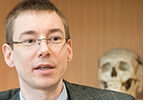
In 2017, Stefan Axmann came to the Institute of Forensic Medicine at the Mainz University Medical Center to establish a forensic physics department. It attracted a lot of attention from the media at the time, which was keen to report on the new facility, the first of its kind in Germany. The physicist himself likes to talk about his enthusiasm for his work and explains how he ended up in Mainz.
 GUTENBERG ALUMNI
A long winter in Antarctica
Physicist Dr. Benjamin Eberhardt from Mainz is living and conducting research at the South Pole for an entire year. Together with his colleague Dr. Kathrin Mallot, he is overseeing the IceCube Neutrino Observatory. The observatory is operated by an international consortium in which Johannes Gutenberg University Mainz (JGU) is a major participant.
 AFRICAN LINGUISTICS
Pilot project on linguistic integration and strategies of language acquisition
The Department of Anthropology and African Studies of Johannes Gutenberg University Mainz (JGU) and the Institute of African Studies of Goethe University Frankfurt initiated the joint pilot project "Africans in the Rhine-Main region" in early 2019. It is dedicated to the currently much-debated sociopolitical issue of linguistic integration. The Rhine-Main Universities (RMU) Initiative Funding for Research finances this partnership undertaking.
 NUCLEAR PHYSICS
New professor in accelerator physics
In September 2018, Professor Atoosa Meseck was appointed Professor of Accelerator Physics – Collective Effects and Nonlinear Beam Dynamics at Johannes Gutenberg University Mainz (JGU). The professorship was instituted in cooperation with the Helmholtz Zentrum Berlin für Materialien und Energie (HZB), where Meseck is researching into novel concepts for particle accelerators. One particular class of components, known as undulators, feature prominently in her work.
 ALEXANDER VON HUMBOLDT PROFESSORSHIP
Highest endowed German research award brings world-class biologist to Mainz University
He is a world-leading cell biologist and chromosome researcher and recipient of an Alexander von Humboldt Professorship, the most highly-endowed research award in Germany: Professor Peter Baumann. In 2017, Baumann left the Howard Hughes Medical Institute in Kansas City in the USA and moved to Germany to work at Johannes Gutenberg University Mainz (JGU), where he supports the strategic realignment and expansion of the life sciences disciplines.
 SPINTRONICS
"We need to get out of our comfort zone"
Professor Jairo Sinova came from Texas A&M University to Johannes Gutenberg University Mainz (JGU) in 2014 to take up an Alexander von Humboldt Professorship. He is one of the world's leading researchers in the field of spintronics and has already set-up the Spin Phenomena Interdisciplinary Center (SPICE) and the Interdisciplinary Spintronics Research (INSPIRE Group) at Mainz University.