
 BIOPHYSICS
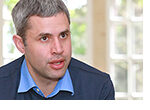
The mystery of flexible proteins
Professor Edward Lemke conducts research into intrinsically disordered proteins. Among other things, he has developed new methods of observing these albumins. He has been a professor at the Faculty of Biology of Johannes Gutenberg University Mainz (JGU) since January 1, 2018. Here he works in collaboration with the Faculty of Chemistry, Pharmaceutical Sciences, and Geosciences. He is also Adjunct Director of the Institute of Molecular Biology (IMB) and a Fellow of the Gutenberg Research College (GRC).
 PRISMA CLUSTER OF EXCELLENCE
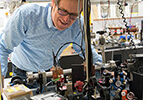
The proton radius puzzle
His results have made headlines beyond the academic world of physics. In May 2016, Randolf Pohl was appointed to a professorship at the PRISMA Cluster of Excellence of Johannes Gutenberg University Mainz (JGU). Using a new technique, he succeeded in measuring the size of the proton, one of the fundamental building blocks of the atomic nucleus. According to his results, the radius of the proton is four percent smaller than the previous value accepted by science. This result is puzzling and could have serious consequences for the Standard Model of particle physics.
 PRISMA CLUSTER OF EXCELLENCE
Making the invisible visible
It is the first exhibition in the School of Seeing on the Gutenberg campus that is concerned with the natural sciences. Through its ZoomIn—Making the Invisible Visible show, the Precision Physics, Fundamental Interactions and Structure of Matter Cluster of Excellence, or PRISMA for short, is providing insight into its many and varied branches of research. Multimedia exhibits show how modern technology is used to gain an in-depth view of the world’s tool box.
 GUINNESS WORLD RECORDS
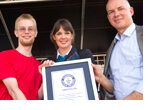
A Guinness World Record for Mainz physicists
By constructing the longest magnetic ball accelerator in the world, Johannes Gutenberg University Mainz (JGU) set a new official Guinness World RecordTM. A team of physicists, supported by high schoolers from two schools in Mainz, worked for months on the project. The Mainz Public Transport Authority even cleared one of its tram lines for the world record experiment. When the final ball crossed the finishing line, the Mainz physicists started celebrating with hundreds of visitors of all ages.
 RESEARCH ROCKET
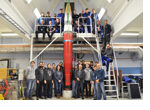
Pioneering measurements in space
The MAIUS-1 sounding rocket mission has enabled physicists to generate a Bose-Einstein condensate in space for the first time. This will allow them to measure the Earth's gravitational field more precisely in the future and, crucially, to test Einstein's equivalence principle more accurately than ever before. The research group Experimental Quantum Optics and Quantum Information at Johannes Gutenberg University Mainz (JGU) is closely involved in the project.
 MAINZ PARTICLE PHYSICS ACADEMY
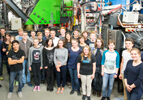
Doing research like a real scientist
During this year's summer break, 24 high school students from all over Germany came to Mainz University to visit the MAMI Microtron, a particle accelerator that generates electron beams. At the invitation of the PRISMA Cluster of Excellence, they attended the first Mainz Particle Physics Academy here on the Gutenberg Campus. Professor Matthias Schott of the Institute of Physics at Johannes Gutenberg University Mainz (JGU) designed and organized the event bringing together top-flight research and teaching for two weeks.
 RHINE-MAIN UNIVERSITIES
In shape for the German Excellence Strategy competition
The Rhine-Main Neuroscience Network (rmn²) looks back on five successful years and is now preparing to meet the challenges of the next half decade. rmn2 is expanding and planning to prove its scientific strength in the upcoming Excellence Strategy competition. Some 300 neuroscientists based in the Rhine-Main region came together for a three-day symposium during which they exchanged views, listened to presentations given by eminent colleagues, and drew up plans for the future.
 UNIVERSITY MEDICAL CENTER
Center for Rare Diseases
The Center for Rare Diseases of the Nervous System (ZSEN) at Mainz University Medical Center was opened in late 2015. It is a key node in a new network of centers designed to treat people with rare diseases. It was previously the case that the majority of people suffering from these diseases had very low chances of receiving the correct diagnosis or successful treatment.
 MAINZ UNIVERSITY FUND FOUNDATION
A stroke of luck for the university
The Mainz University Fund Foundation was created in 1781. Since then it has survived not only the closure of the original electoral university by Napoleon, but also both world wars. The foundation's capital is invested in rental apartments and property, but primarily in attractive agricultural land and vineyards. These days, the revenues from the fund provide an important resource that helps support research and teaching at Johannes Gutenberg University Mainz (JGU).
 CLEMENS BRENTANO COLLECTION
The mouse, the poet, and the dance
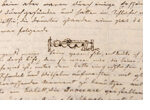
The Clemens Brentano Collection provides intimate insights into the life and world of one of the greatest German Romantic poets. Along with hundreds of examples of lively correspondence, there are drafts of poems and household plans, outlines for dramas and drawings. The collection, which was acquired by Johannes Gutenberg University Mainz (JGU) in 1950, is housed in the Mainz City Library.